PDF Download Originals: How Non-Conformists Move the World, by Adam Grant
Reviewing habit will certainly constantly lead individuals not to completely satisfied reading Originals: How Non-Conformists Move The World, By Adam Grant, a book, 10 book, hundreds e-books, as well as more. One that will make them really feel completely satisfied is finishing reading this publication Originals: How Non-Conformists Move The World, By Adam Grant as well as getting the notification of guides, after that locating the other following e-book to read. It continues more as well as more. The moment to complete checking out an e-book Originals: How Non-Conformists Move The World, By Adam Grant will certainly be consistently various depending on spar time to invest; one example is this Originals: How Non-Conformists Move The World, By Adam Grant
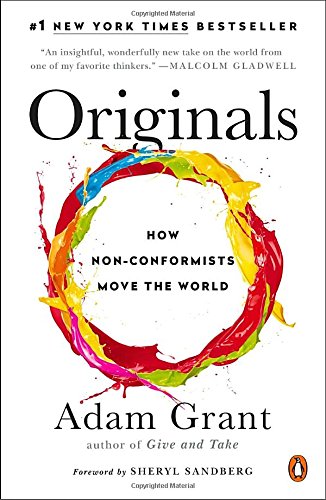
Originals: How Non-Conformists Move the World, by Adam Grant

PDF Download Originals: How Non-Conformists Move the World, by Adam Grant
Use the sophisticated technology that human establishes this day to locate guide Originals: How Non-Conformists Move The World, By Adam Grant quickly. However first, we will certainly ask you, just how much do you enjoy to review a book Originals: How Non-Conformists Move The World, By Adam Grant Does it consistently up until coating? For what does that book read? Well, if you really enjoy reading, aim to review the Originals: How Non-Conformists Move The World, By Adam Grant as one of your reading compilation. If you only checked out guide based on requirement at the time and unfinished, you need to aim to such as reading Originals: How Non-Conformists Move The World, By Adam Grant initially.
When some people looking at you while checking out Originals: How Non-Conformists Move The World, By Adam Grant, you may really feel so pleased. However, rather than other people feels you should instil in on your own that you are reading Originals: How Non-Conformists Move The World, By Adam Grant not due to that reasons. Reading this Originals: How Non-Conformists Move The World, By Adam Grant will certainly offer you more than individuals appreciate. It will certainly overview of know more than individuals staring at you. Even now, there are many resources to learning, reading a publication Originals: How Non-Conformists Move The World, By Adam Grant still becomes the first choice as a fantastic way.
Why should be reading Originals: How Non-Conformists Move The World, By Adam Grant Once again, it will certainly rely on exactly how you really feel and also think of it. It is definitely that people of the advantage to take when reading this Originals: How Non-Conformists Move The World, By Adam Grant; you can take much more lessons straight. Even you have not undertaken it in your life; you could obtain the experience by reading Originals: How Non-Conformists Move The World, By Adam Grant And currently, we will introduce you with the on-line book Originals: How Non-Conformists Move The World, By Adam Grant in this internet site.
What type of book Originals: How Non-Conformists Move The World, By Adam Grant you will favor to? Currently, you will certainly not take the published book. It is your time to obtain soft file book Originals: How Non-Conformists Move The World, By Adam Grant rather the printed files. You can enjoy this soft documents Originals: How Non-Conformists Move The World, By Adam Grant in any time you anticipate. Also it remains in anticipated place as the various other do, you can check out guide Originals: How Non-Conformists Move The World, By Adam Grant in your device. Or if you want more, you can continue reading your computer or laptop computer to obtain full display leading. Juts locate it here by downloading and install the soft data Originals: How Non-Conformists Move The World, By Adam Grant in link page.
The #1 New York Times bestseller that examines how people can champion new ideas—and how leaders can fight groupthink, from the author of�Give and Take
“Reading Originals made me feel like I was seated across from Adam Grant at a dinner party, as one of my favorite thinkers thrilled me with his insights and his wonderfully new take on the world.”�—Malcolm Gladwell, author of Outliers�and�The Tipping Point
“Originals is one of the most important and captivating books I have ever read, full of surprising and powerful ideas. It will not only change the way you see the world; it might just change the way you live your life. And it could very well inspire you to change your world.” —Sheryl Sandberg, COO of Facebook and author of�Lean In
With Give and Take, Adam Grant not only introduced a landmark new paradigm for success but also established himself as one of his generation’s most compelling and provocative thought leaders. In Originals he again addresses the challenge of improving the world, but now from the perspective of becoming original: choosing to champion novel ideas and values that go against the grain, battle conformity, and buck outdated traditions. How can we originate new ideas, policies, and practices without risking it all?
�
Using surprising studies and stories spanning business, politics, sports, and entertainment, Grant explores how to recognize a good idea, speak up without getting silenced, build a coalition of allies, choose the right time to act, and manage fear and doubt; how parents and teachers can nurture originality in children; and how leaders can build cultures that welcome dissent. Learn from an entrepreneur who pitches his start-ups by highlighting the reasons not to invest, a woman at Apple who challenged Steve Jobs from three levels below, an analyst who overturned the rule of secrecy at the CIA, a billionaire financial wizard who fires employees for failing to criticize him, and a TV executive who didn’t even work in comedy but saved Seinfeld from the cutting-room floor. The payoff is a set of groundbreaking insights about rejecting conformity and improving the status quo.
- Sales Rank: #902 in Books
- Published on: 2017-02-07
- Released on: 2017-02-07
- Original language: English
- Dimensions: 8.40" h x .72" w x 5.50" l, .81 pounds
- Binding: Paperback
- 336 pages
Review
“Part of the fun of Grant’s book is that he redeems behaviors we typically regard with puritan disdain. . . . Thought-provoking.”
—The New York Times Book Review
�
“Fresh research, counter-intuitive insights, lively writing, practical calls to action . . . Grant has a deserved reputation as an original thinker.”
—The Financial Times
�
“Grant’s latest looks set to join the required reading lists of many companies across America.”
—Wired.com
�
“[Grant] examines what successful non-conformists . . . have in common, all in an effort to help the rest of us learn how to do things like bust myths, speak truth to power, and avoid groupthink without getting sidelined.”
—The Washington Post
�
“Adam Grant is a serious social scientist, master storyteller and infectious optimist. . . . Originals is filled with fresh insights on a broad array of topics that are important to our personal and professional lives. Mr. Grant has an uncanny ability to infuse a familiar topic with deeper meaning and leave the reader feeling hopeful and a little exhilarated.”
—The New York Times DealBook
“This extraordinary, wildly entertaining book sheds new light on the Age of Disruption. What does it take to make a meaningful difference? And how can you apply this insight to your own life? By debunking myths of success stories, challenging long-held beliefs of process, and finding commonality among those who are agents of profound change, Adam Grant gives us a powerful new perspective on not just our place in the world, but our potential to shake it up entirely.”
—JJ Abrams, director of Star Wars: The Force Awakens, co-creator and executive producer of Lost, and cofounder of Bad Robot
“After launching hundreds of businesses—from airlines to trains, music to mobile, and now a spaceline—my biggest challenges and successes have come from convincing other people to see the world differently. Originals reveals how that can be done and will help you inspire creativity and change.”
—Sir Richard Branson, founder of The Virgin Group
“Originals�is a fascinating, eye-opening read that will help you not just recognize your own unique gifts, but find the strength to challenge conventional wisdom to bring them to life. Using surprising studies and riveting stories, Adam Grant brilliantly shows us how to champion new ideas, bust persistent myths that hold us back and change not only our lives, but our world.”
—Arianna Huffington, cofounder and editor-in-chief of The Huffington Post, and author of Thrive
“It can sometimes seem as if one must learn everything old before one can try anything new. Adam Grant does a masterful job showing that is not the case; we are lucky to have him as a guide.”
—Peter Thiel, cofounder of PayPal and Palantir, and author of Zero to One
“An urgent must read, a seminal work that will surprise you on every single page. Adam Grant has reset our expectations for what it means to be creative and what's required to make a difference. Share it with someone you care about.”
—Seth Godin, author of Linchpin
Praise for Give and Take
�
“As brilliant as it is wise, this is not just a book—it’s a new and shining worldview. Adam Grant is one of the great social scientists of our time, and Give and Take is brimming with life-changing insights.”
—Susan Cain, author of Quiet
�
“Give and Take is a truly exhilarating book—the rare work that will shatter your assumptions about how the world works and keep your brain firing for weeks after you’ve turned the last page.”
—Daniel H. Pink, author of Drive and To Sell Is Human
�
“I love Give and Take, which shows that givers get ahead and nice guys don’t finish last.”
—Arianna Huffington, author of Thrive and president of the Huffington Post Media Group
�
“Now shaking up the business world: science that may change the way the world does business.”
—Willie Geist, Today show�
�
“Adam Grant’s Give and Take is an excellent book. Hard work, luck, and talent are important, but giving makes the difference.”
—Alex Stubb, prime minister of Finland
�
“Give and Take is like a fundamental outline as to how to be successful. . . . Highly recommended read.”
—Ashton Kutcher, actor, director, and technology investor
�
“Give and Take is a very interesting book. . . . I can’t put it down.”
—Ryan Seacrest, host of American Idol
�
“Give and Take just might be the most important book of this young century. As insightful and entertaining as Malcolm Gladwell at his best, this book has profound implications for how we manage our careers, deal with our friends and relatives, raise our children, and design our institutions. This gem is a joy to read, and it shatters the myth that greed is the path to success.”
—Robert Sutton, author of The No *sshole Rule and Good Boss, Bad Boss
About the Author
Adam Grant is Wharton’s top-rated teacher. He has been recognized as one of HR’s most influential international thinkers, BusinessWeek’s favorite professor, one of the world’s forty best business professors under forty. Grant was tenured at Wharton while still in his twenties and has been honored with the Excellence in Teaching Award for every class he has taught. His first book, Give and Take, was a New York Times bestseller translated into twenty-seven languages and named one of the best books of 2013 by Amazon, Apple, the Financial Times, and the Wall Street Journal—as well as one of Oprah’s riveting reads, Fortune’s must-read business books,�Harvard Business Review’s ideas that shaped management, and the Washington Post’s books every leader should read. His speaking and consulting clients include Google, the NFL, Merck, Goldman Sachs, Disney Pixar, the United Nations, and the U.S. Army and Navy. He serves as a contributing op-ed writer for the New York Times and was profiled in a cover story by its magazine.�Author of the New York Times bestseller Originals, Grant earned his Ph.D. in organizational psychology from the University of Michigan and his B.A. from Harvard College.
Excerpt. � Reprinted by permission. All rights reserved.
Foreword
Adam Grant is the perfect person to write Originals because he is one.
He is a brilliant researcher who passionately pursues the science of what motivates people, busting myths and revealing truths. He is an informed optimist who offers insights and advice about how anyone—at home, at work, in the community—can make the world a better place. He is a dedicated friend who inspires me to believe in myself and has helped me understand how I can advocate effectively for my ideas.
Adam is one of the most important influences in my life. Through the pages of this magnificent book, he will enlighten, inspire, and support you as well.
MYTH BUSTER
Conventional wisdom holds that some people are innately creative, while most have few original thoughts. Some people are born to be leaders, and the rest are followers. Some people can have real impact, but the majority can’t.
In Originals Adam shatters all of these assumptions.
He demonstrates that any of us can enhance our creativity. He reveals how we can identify ideas that are truly original and predict which ones will work. He tells us when to trust our gut and when to rely on others. He shows how we can become better parents by nurturing originality in our children and better managers by fostering diversity of thought instead of conformity.
In these pages, I learned that great creators don’t necessarily have the deepest expertise but rather seek out the broadest perspectives. I saw how success is not usually attained by being ahead of everyone else but by waiting patiently for the right time to act. And to my utter shock, I learned that procrastinating can be good. Anyone who has ever worked with me knows how much I hate leaving things to the last minute, how I always think that anything that can be done should be done right away. Mark Zuckerberg, along with many others, will be pleased if I can let go of the relentless pressure I feel to finish everything early—and, as Adam points out, it might just help me and my teams achieve better results.
INFORMED OPTIMIST
Every day, we all encounter things we love and things that need to change. The former give us joy. The latter fuel our desire to make the world different—ideally better than the way we found it. But trying to change deep-seated beliefs and behaviors is daunting. We accept the status quo because effecting real change seems impossible. Still, we dare to ask: Can one individual make a difference? And, in our bravest moments: Could that one individual be me?
Adam’s answer is a resounding yes. This book proves that any one of us can champion ideas that improve the world around us.
FRIEND
I met Adam just as his first book, Give and Take, was generating buzz in Silicon Valley. I read it and immediately started quoting it to anyone who would listen. Adam was not only a talented researcher but also a gifted teacher and storyteller who was able to explain complicated ideas simply and clearly.
Then my husband invited Adam to speak to his team at work and brought him over for dinner. Adam was every bit as extraordinary in person as he was on paper. His knowledge was encyclopedic and his energy was contagious. He and I started talking about how his research could inform the debate on gender and began working together. We have done so ever since, conducting research and writing a series of op-eds about women and work. LeanIn.Org has benefited immensely from his rigorous analysis and commitment to equality.
Once a year, Facebook brings its global teams together, and in 2015 I invited Adam to give a keynote speech. Everyone was blown away by his wisdom and humor. Months later, the teams are still talking about his insights and putting his advice into action.
Along the way, Adam and I became friends. When tragedy hit and I lost my husband suddenly, Adam stepped up and stepped in as only a true friend would. He approached the worst time of my life as he approaches everything, combining his unique understanding of psychology with his unparalleled generosity. When I thought I would never feel better, he flew across the country to explain what I could do to build my resilience. When I could not figure out how to handle a particularly gut-wrenching situation, he helped me find answers where I thought there were none. When I needed a shoulder to cry on, his was always there.
In the deepest sense of the word, a friend is someone who sees more potential in you than you see in yourself, someone who helps you become the best version of yourself. The magic of this book is that Adam becomes that kind of friend to everyone who reads it. He offers a wealth of advice for overcoming doubt and fear, speaking up and pitching ideas, and finding allies in the least likely of places. He gives practical guidance on how to manage anxiety, channel anger, find the strength in our weaknesses, overcome obstacles, and give hope to others.
—
Originals is one of the most important and captivating books I have ever read, full of surprising and powerful ideas. It will not only change the way you see the world; it might just change the way you live your life. And it could very well inspire you to change your world.
1
Creative Destruction
The Risky Business of Going Against the Grain
“The reasonable man adapts himself to the world; the unreasonable one persists in trying to adapt the world to himself. Therefore all progress depends on the unreasonable man.”
George Bernard Shaw
On a cool fall evening in 2008, four students set out to revolutionize an industry. Buried in loans, they had lost and broken eyeglasses and were outraged at how much it cost to replace them. One of them had been wearing the same damaged pair for five years: He was using a paper clip to bind the frames together. Even after his prescription changed twice, he refused to pay for pricey new lenses.
Luxottica, the 800-pound gorilla of the industry, controlled more than 80 percent of the eyewear market. To make glasses more affordable, the students would need to topple a giant. Having recently watched Zappos transform footwear by selling shoes online, they wondered if they could do the same with eyewear.
When they casually mentioned their idea to friends, time and again they were blasted with scorching criticism. No one would ever buy glasses over the internet, their friends insisted. People had to try them on first. Sure, Zappos had pulled the concept off with shoes, but there was a reason it hadn’t happened with eyewear. “If this were a good idea,” they heard repeatedly, “someone would have done it already.”
None of the students had a background in e-commerce and technology, let alone in retail, fashion, or apparel. Despite being told their idea was crazy, they walked away from lucrative job offers to start a company. They would sell eyeglasses that normally cost $500 in a store for $95 online, donating a pair to someone in the developing world with every purchase.
The business depended on a functioning website. Without one, it would be impossible for customers to view or buy their products. After scrambling to pull a website together, they finally managed to get it online at 4 A.M. on the day before the launch in February 2010. They called the company Warby Parker, combining the names of two characters created by the novelist Jack Kerouac, who inspired them to break free from the shackles of social pressure and embark on their adventure. They admired his rebellious spirit, infusing it into their culture. And it paid off.
The students expected to sell a pair or two of glasses per day. But when GQ called them “the Netflix of eyewear,” they hit their target for the entire first year in less than a month, selling out so fast that they had to put twenty thousand customers on a waiting list. It took them nine months to stock enough inventory to meet the demand.
Fast forward to 2015, when Fast Company released a list of the world’s most innovative companies. Warby Parker didn’t just make the list—they came in first. The three previous winners were creative giants Google, Nike, and Apple, all with over fifty thousand employees. Warby Parker’s scrappy startup, a new kid on the block, had a staff of just five hundred. In the span of five years, the four friends built one of the most fashionable brands on the planet and donated over a million pairs of glasses to people in need. The company cleared $100 million in annual revenues and was valued at over $1 billion.
Back in 2009, one of the founders pitched the company to me, offering me the chance to invest in Warby Parker. I declined.
It was the worst financial decision I’ve ever made, and I needed to understand where I went wrong.
—
orig•i•nal, adj The origin or source of something; from which something springs, proceeds, or is derived.
orig•i•nal, n A thing of singular or unique character; a person who is different from other people in an appealing or interesting way; a person of fresh initiative or inventive capacity.
Years ago, psychologists discovered that there are two routes to achievement: conformity and originality. Conformity means following the crowd down conventional paths and maintaining the status quo. Originality is taking the road less traveled, championing a set of novel ideas that go against the grain but ultimately make things better.
Of course, nothing is completely original, in the sense that all of our ideas are influenced by what we learn from the world around us. We are constantly borrowing thoughts, whether intentionally or inadvertently. We’re all vulnerable to “kleptomnesia”—accidentally remembering the ideas of others as our own. By my definition, originality involves introducing and advancing an idea that’s relatively unusual within a particular domain, and that has the potential to improve it.
Originality itself starts with creativity: generating a concept that is both novel and useful. But it doesn’t stop there. Originals are people who take the initiative to make their visions a reality. The Warby Parker founders had the originality to dream up an unconventional way to sell glasses online, but became originals by taking action to make them easily accessible and affordable.
This book is about how we can all become more original. There’s a surprising clue in the web browser that you use to surf the internet.
Finding the Faults in Defaults
Not long ago, economist Michael Housman was leading a project to figure out why some customer service agents stayed in their jobs longer than others. Armed with data from over thirty thousand employees who handled calls for banks, airlines, and cell-phone companies, he suspected that their employment histories would contain telltale signs about their commitment. He thought that people with a history of job-hopping would quit sooner, but they didn’t: Employees who had held five jobs in the past five years weren’t any more likely to leave their positions than those who had stayed in the same job for five years.
Hunting for other hints, he noticed that his team had captured information about which internet browser employees had used when they logged in to apply for their jobs. On a whim, he tested whether that choice might be related to quitting. He didn’t expect to find any correlation, assuming that browser preference was purely a matter of taste. But when he looked at the results, he was stunned: Employees who used Firefox or Chrome to browse the Web remained in their jobs 15 percent longer than those who used Internet Explorer or Safari.
Thinking it was a coincidence, Housman ran the same analysis for absences from work. The pattern was the same: Firefox and Chrome users were 19 percent less likely to miss work than Internet Explorer and Safari fans.
Then he looked at performance. His team had assembled nearly three million data points on sales, customer satisfaction, and average call length. The Firefox and Chrome users had significantly higher sales, and their call times were shorter. Their customers were happier, too: After 90 days on the job, the Firefox and Chrome users had customer satisfaction levels that Internet Explorer and Safari users reached only after 120 days at work.
It’s not the browser itself that’s causing them to stick around, show up dependably, and succeed. Rather, it’s what their browser preference signals about their habits. Why are the Firefox and Chrome users more committed and better performers on every metric?
The obvious answer was that they’re more tech savvy, so I asked Housman if he could explore that. The employees had all taken a computer proficiency test, which assessed their knowledge of keyboard shortcuts, software programs, and hardware, as well as a timed test of their typing speed. But the Firefox and Chrome group didn’t prove to have significantly more computer expertise, and they weren’t faster or more accurate typists. Even after accounting for those scores, the browser effect persisted. Technical knowledge and skill weren’t the source of their advantage.
What made the difference was how they obtained the browser. If you own a PC, Internet Explorer is built into Windows. If you’re a Mac user, your computer came preinstalled with Safari. Almost two thirds of the customer service agents used the default browser, never questioning whether a better one was available.
To get Firefox or Chrome, you have to demonstrate some resourcefulness and download a different browser. Instead of accepting the default, you take a bit of initiative to seek out an option that might be better. And that act of initiative, however tiny, is a window into what you do at work.
The customer service agents who accepted the defaults of Internet Explorer and Safari approached their job the same way. They stayed on script in sales calls and followed standard operating procedures for handling customer complaints. They saw their job descriptions as fixed, so when they were unhappy with their work, they started missing days, and eventually just quit.
The employees who took the initiative to change their browsers to Firefox or Chrome approached their jobs differently. They looked for novel ways of selling to customers and addressing their concerns. When they encountered a situation they didn’t like, they fixed it. Having taken the initiative to improve their circumstances, they had little reason to leave. They created the jobs they wanted. But they were the exception, not the rule.
We live in an Internet Explorer world. Just as almost two thirds of the customer service reps used the default browser on their computers, many of us accept the defaults in our own lives. In a series of provocative studies, a team led by political psychologist John Jost explored how people responded to undesirable default conditions. Compared to European Americans, African Americans were less satisfied with their economic circumstances but perceived economic inequality as more legitimate and just. Compared to people in the highest income bracket, people in the lowest income bracket were 17 percent more likely to view economic inequality as necessary. And when asked whether they would support laws that limit the rights of citizens and the press to criticize the government if enacting such legislation was necessary to solve our nation’s problems, twice as many people in the lowest income bracket were willing to give up the right to free speech as those in the highest income bracket. After finding that disadvantaged groups consistently support the status quo more than advantaged groups, Jost and his colleagues concluded: “People who suffer the most from a given state of affairs are paradoxically the least likely to question, challenge, reject, or change it.”
To explain this peculiar phenomenon, Jost’s team developed a theory of system justification. Its core idea is that people are motivated to rationalize the status quo as legitimate—even if it goes directly against their interests. In one study, they tracked Democratic and Republican voters before the 2000 U.S. presidential election. When George W. Bush gained in the polls, Republicans rated him as more desirable, but so did Democrats, who were already preparing justifications for the anticipated status quo. The same happened when Al Gore’s likelihood of success increased: Both Republicans and Democrats judged him more favorably. Regardless of political ideologies, when a candidate seemed destined to win, people liked him more. When his odds dropped, they liked him less.
Justifying the default system serves a soothing function. It’s an emotional painkiller: If the world is supposed to be this way, we don’t need to be dissatisfied with it. But acquiescence also robs us of the moral outrage to stand against injustice and the creative will to consider alternative ways that the world could work.
—
The hallmark of originality is rejecting the default and exploring whether a better option exists. I’ve spent more than a decade studying this, and it turns out to be far less difficult than I expected.
The starting point is curiosity: pondering why the default exists in the first place. We’re driven to question defaults when we experience vuja de, the opposite of d�j� vu. D�j� vu occurs when we encounter something new, but it feels as if we’ve seen it before. Vuja de is the reverse—we face something familiar, but we see it with a fresh perspective that enables us to gain new insights into old problems.
Without a vuja de event, Warby Parker wouldn’t have existed. When the founders were sitting in the computer lab on the night they conjured up the company, they had spent a combined sixty years wearing glasses. The product had always been unreasonably expensive. But until that moment, they had taken the status quo for granted, never questioning the default price. “The thought had never crossed my mind,” cofounder Dave Gilboa says. “I had always considered them a medical purchase. I naturally assumed that if a doctor was selling it to me, there was some justification for the price.”
Having recently waited in line at the Apple Store to buy an iPhone, he found himself comparing the two products. Glasses had been a staple of human life for nearly a thousand years, and they’d hardly changed since his grandfather wore them. For the first time, Dave wondered why glasses had such a hefty price tag. Why did such a fundamentally simple product cost more than a complex smartphone?
Anyone could have asked those questions and arrived at the same answer that the Warby Parker squad did. Once they became curious about why the price was so steep, they began doing some research on the eyewear industry. That’s when they learned that it was dominated by Luxottica, a European company that had raked in over $7 billion the previous year. “Understanding that the same company owned LensCrafters and Pearle Vision, Ray-Ban and Oakley, and the licenses for Chanel and Prada prescription frames and sunglasses—all of a sudden, it made sense to me why glasses were so expensive,” Dave says. “Nothing in the cost of goods justified the price.” Taking advantage of its monopoly status, Luxottica was charging twenty times the cost. The default wasn’t inherently legitimate; it was a choice made by a group of people at a given company. And this meant that another group of people could make an alternative choice. “We could do things differently,” Dave suddenly understood. “It was a realization that we could control our own destiny, that we could control our own prices.”
When we become curious about the dissatisfying defaults in our world, we begin to recognize that most of them have social origins: Rules and systems were created by people. And that awareness gives us the courage to contemplate how we can change them. Before women gained the right to vote in America, many “had never before considered their degraded status as anything but natural,” historian Jean Baker observes. As the suffrage movement gained momentum, “a growing number of women were beginning to see that custom, religious precept, and law were in fact man-made and therefore reversible.”
The Two Faces of Ambition
The pressures to accept defaults start much earlier than we realize. If you consider the individuals who will grow up and make a dent in the universe, the first group that probably comes to mind is child prodigies. These geniuses learn to read at age two, play Bach at four, breeze through calculus at six, and speak seven languages fluently by eight. Their classmates shudder with jealousy; their parents rejoice at having won the lottery. But to paraphrase T. S. Eliot, their careers tend to end not with a bang, but a whimper.
Child prodigies, it turns out, rarely go on to change the world. When psychologists study history’s most eminent and influential people, they discover that many of them weren’t unusually gifted as children. And if you assemble a large group of child prodigies and follow them for their entire lives, you’ll find that they don’t outshine their less precocious peers from families of similar means.
Intuitively, this makes sense. We assume that what gifted kids have in book smarts, they lack in street smarts. While they have the intellectual chops, they must lack the social, emotional, and practical skills to function in society. When you look at the evidence, though, this explanation falls short: Less than a quarter of gifted children suffer from social and emotional problems. The vast majority are well-adjusted—as delightful at a cocktail party as in a spelling bee.
Although child prodigies are often rich in both talent and ambition, what holds them back from moving the world forward is that they don’t learn to be original. As they perform in Carnegie Hall, win the science Olympics, and become chess champions, something tragic happens: Practice makes perfect, but it doesn’t make new. The gifted learn to play magnificent Mozart melodies and beautiful Beethoven symphonies, but never compose their own original scores. They focus their energy on consuming existing scientific knowledge, not producing new insights. They conform to the codified rules of established games, rather than inventing their own rules or their own games. All along the way, they strive to earn the approval of their parents and the admiration of their teachers.
Research demonstrates that it is the most creative children who are the least likely to become the teacher’s pet. In one study, elementary school teachers listed their favorite and least favorite students, and then rated both groups on a list of characteristics. The least favorite students were the non-conformists who made up their own rules. Teachers tend to discriminate against highly creative students, labeling them as troublemakers. In response, many children quickly learn to get with the program, keeping their original ideas to themselves. In the language of author William Deresiewicz, they become the world’s most excellent sheep.
In adulthood, many child prodigies become experts in their fields and leaders in their organizations. Yet “only a fraction of gifted children eventually become revolutionary adult creators,” laments psychologist Ellen Winner. “Those who do must make a painful transition” from a child who “learns rapidly and effortlessly in an established domain” to an adult who “ultimately remakes a domain.”
Most prodigies never make that leap. They apply their extraordinary abilities in ordinary ways, mastering their jobs without questioning defaults and without making waves. In every domain they enter, they play it safe by following the conventional paths to success. They become doctors who heal their patients without fighting to fix the broken systems that prevent many patients from affording health care in the first place. They become lawyers who defend clients for violating outdated laws without trying to transform the laws themselves. They become teachers who plan engaging algebra lessons without questioning whether algebra is what their students need to learn. Although we rely on them to keep the world running smoothly, they keep us running on a treadmill.
Child prodigies are hindered by achievement motivation. The drive to succeed is responsible for many of the world’s greatest accomplishments. When we’re determined to excel, we have the fuel to work harder, longer, and smarter. But as cultures rack up a significant number of achievements, originality is increasingly left to a specialized few.
When achievement motivation goes sky-high, it can crowd out originality: The more you value achievement, the more you come to dread failure. Instead of aiming for unique accomplishments, the intense desire to succeed leads us to strive for guaranteed success. As psychologists Todd Lubart and Robert Sternberg put it, “Once people pass an intermediate level in the need to achieve, there is evidence that they actually become less creative.”
The drive to succeed and the accompanying fear of failure have held back some of the greatest creators and change agents in history. Concerned with maintaining stability and attaining conventional achievements, they have been reluctant to pursue originality. Instead of charging full steam ahead with assurance, they have been coaxed, convinced, or coerced to take a stand. While they may seem to have possessed the qualities of natural leaders, they were figuratively—and sometimes literally—lifted up by followers and peers. If a handful of people hadn’t been cajoled into taking original action, America might not exist, the civil rights movement could still be a dream, the Sistine Chapel might be bare, we might still believe the sun revolves around the earth, and the personal computer might never have been popularized.
From our perspective today, the Declaration of Independence seems inevitable, but it nearly didn’t happen due to the reluctance of key revolutionaries. “The men who took commanding roles in the American Revolution were as unlikely a group of revolutionaries as one can imagine,” Pulitzer Prize–winning historian Jack Rakove recounts. “They became revolutionaries despite themselves.” In the years leading up to the war, John Adams feared British retaliation and hesitated to give up his budding law career; he only got involved after being elected as a delegate to the First Continental Congress. George Washington had been focused on managing his wheat, flour, fishing, and horse-breeding businesses, joining the cause only after Adams nominated him as commander in chief of the army. “I have used every endeavor in my power to avoid it,” Washington wrote.
Nearly two centuries later, Martin Luther King, Jr., was apprehensive about leading the civil rights movement; his dream was to be a pastor and a college president. In 1955, after Rosa Parks was tried for refusing to give up her seat at the front of a bus, a group of civil rights activists gathered to discuss their response. They agreed to form the Montgomery Improvement Association and launch a bus boycott, and one of the attendees nominated King for the presidency. “It had happened so quickly that I did not even have time to think it through. It is probable that if I had, I would have declined the nomination,” King reflected. Just three weeks earlier, King and his wife had “agreed that I should not then take on any heavy community responsibilities, since I had so recently finished my thesis, and needed to give more attention to my church work.” He was unanimously elected to lead the boycott. Faced with giving a speech to the community that evening, “I became possessed by fear.” King would overcome that trepidation soon enough that in 1963 his thundering voice united a country around an electrifying vision of freedom. But that only happened because a colleague proposed that King should be the closing speaker at the March on Washington and gathered a coalition of leaders to advocate for him.
When the pope commissioned him to paint a fresco on the ceiling of the Sistine Chapel, Michelangelo wasn’t interested. He viewed himself as a sculptor, not a painter, and found the task so overwhelming that he fled to Florence. Two years would pass before he began work on the project, at the pope’s insistence. And astronomy stagnated for decades because Nicolaus Copernicus refused to publish his original discovery that the earth revolves around the sun. Fearing rejection and ridicule, he stayed silent for twenty-two years, circulating his findings only to his friends. Eventually, a major cardinal learned of his work and wrote a letter encouraging Copernicus to publish it. Even then, Copernicus stalled for four more years. His magnum opus only saw the light of day after a young mathematics professor took matters into his own hands and submitted it for publication.
Almost half a millennium later, when an angel investor offered $250,000 to Steve Jobs and Steve Wozniak to bankroll Apple in 1977, it came with an ultimatum: Wozniak would have to leave Hewlett-Packard. He refused. “I still intended to be at that company forever,” Wozniak reflects. “My psychological block was really that I didn’t want to start a company. Because I was just afraid,” he admits. Wozniak changed his mind only after being encouraged by Jobs, multiple friends, and his own parents.
We can only imagine how many Wozniaks, Michelangelos, and Kings never pursued, publicized, or promoted their original ideas because they were not dragged or catapulted into the spotlight. Although we may not all aspire to start our own companies, create a masterpiece, transform Western thought, or lead a civil rights movement, we do have ideas for improving our workplaces, schools, and communities. Sadly, many of us hesitate to take action to promote those ideas. As economist Joseph Schumpeter famously observed, originality is an act of creative destruction. Advocating for new systems often requires demolishing the old way of doing things, and we hold back for fear of rocking the boat. Among nearly a thousand scientists at the Food and Drug Administration, more than 40 percent were afraid that they would face retaliation if they spoke up publicly about safety concerns. Of more than forty thousand employees at a technology company, half felt it was not safe to voice dissenting opinions at work. When employees in consulting, financial services, media, pharmaceuticals, and advertising companies were interviewed, 85 percent admitted to keeping quiet about an important concern rather than voicing it to their bosses.
The last time you had an original idea, what did you do with it? Although America is a land of individuality and unique self-expression, in search of excellence and in fear of failure, most of us opt to fit in rather than stand out. “On matters of style, swim with the current,” Thomas Jefferson allegedly advised, but “on matters of principle, stand like a rock.” The pressure to achieve leads us to do the opposite. We find surface ways of appearing original—donning a bow tie, wearing bright red shoes—without taking the risk of actually being original. When it comes to the powerful ideas in our heads and the core values in our hearts, we censor ourselves. “There are so few originals in life,” says renowned executive Mellody Hobson, because people are afraid to “speak up and stand out.” What are the habits of the people whose originality extends beyond appearance to effective action?
The Right Stuff
To be an original, you need to take radical risks. This belief is embedded so deeply in our cultural psyche that we rarely even stop to think about it. We admire astronauts like Neil Armstrong and Sally Ride for having “the right stuff”—the courage to leave the only planet humans have ever inhabited and venture boldly into space. We celebrate heroes like Mahatma Gandhi and Martin Luther King, Jr., who possessed enough conviction to risk their lives for the moral principles they held dear. We idolize icons like Steve Jobs and Bill Gates for having the audacity to drop out of school and go for broke, holing up in garages to will their technological visions into existence.
When we marvel at the original individuals who fuel creativity and drive change in the world, we tend to assume they’re cut from a different cloth. In the same way that some lucky people are born with genetic mutations that make them resistant to diseases like cancer, obesity, and HIV, we believe that great creators are born with a biological immunity to risk. They’re wired to embrace uncertainty and ignore social approval; they simply don’t worry about the costs of non-conformity the way the rest of us do. They’re programmed to be iconoclasts, rebels, revolutionaries, troublemakers, mavericks, and contrarians who are impervious to fear, rejection, and ridicule.
The word entrepreneur, as it was coined by economist Richard Cantillon, literally means “bearer of risk.” When we read the story of Warby Parker’s stratospheric rise, this theme comes through loud and clear. Like all great creators, innovators, and change agents, the quartet transformed the world because they were willing to take a leap of faith. After all, if you don’t swing for the fences, it’s impossible to hit a home run.
Isn’t it?
—
Six months before Warby Parker launched, one of the founders was sitting in my classroom at Wharton. Tall and affable, with curly black hair and a calm energy, Neil Blumenthal hailed from a nonprofit background and genuinely aspired to make the world a better place. When he pitched the company to me, like many other doubters, I told him it sounded like an interesting idea, but it was hard to imagine people ordering glasses online.
With a skeptical consumer base, I knew, it would require a herculean effort to get the company off the ground. And when I learned how Neil and his friends were spending their time preparing for the launch, I had the sinking feeling that they were doomed.
The first strike against them, I told Neil, was that they were all still in school. If they truly believed in Warby Parker, they should drop out to focus every waking hour on making it happen.
“We want to hedge our bets,” he responded. “We’re not sure if it’s a good idea and we have no clue whether it will succeed, so we’ve been working on it in our spare time during the school year. We were four friends before we started, and we made a commitment that dealing with each other fairly was more important than success. But for the summer, Jeff got a grant to focus on the business full time.”
What about the other three of you? “We all got internships,” Neil admitted. “I was in consulting, Andy was in venture capital, and Dave was in health care.”
With their time scarce and their attention divided, they still hadn’t built a website, and it had taken them six months just to agree on a name for the company. Strike two.
Before I gave up on them entirely, though, I remembered that they were all graduating at the end of the year, which meant they’d finally have the time to go all in and dedicate themselves completely to the business. “Well, not necessarily,” Neil backpedaled. “We’ve hedged our bets. Just in case things don’t work out, I’ve accepted a full-time job for after graduation. So has Jeff. And to make sure he would have options, Dave did two different internships over the summer, and he’s talking with his former employer about rejoining.”
Strike three. They were out—and so was I.
I declined to invest in Warby Parker because Neil and his friends were too much like me. I became a professor because I was passionate about discovering new insights, sharing knowledge, and teaching the next generations of students. But in my most honest moments, I know that I was also drawn to the security of tenure. I would never have had the confidence to start a business in my twenties. If I had, I certainly would have stayed in school and lined up a job to cover my bases.
When I compared the choices of the Warby Parker team to my mental model of the choices of successful entrepreneurs, they didn’t match. Neil and his colleagues lacked the guts to go in with their guns blazing, which led me to question their conviction and commitment. They weren’t serious about becoming successful entrepreneurs: They didn’t have enough skin in the game. In my mind, they were destined to fail because they played it safe instead of betting the farm. But in fact, this is exactly why they succeeded.
I want to debunk the myth that originality requires extreme risk taking and persuade you that originals are actually far more ordinary than we realize. In every domain, from business and politics to science and art, the people who move the world forward with original ideas are rarely paragons of conviction and commitment. As they question traditions and challenge the status quo, they may appear bold and self-assured on the surface. But when you peel back the layers, the truth is that they, too, grapple with fear, ambivalence, and self-doubt. We view them as self-starters, but their efforts are often fueled and sometimes forced by others. And as much as they seem to crave risk, they really prefer to avoid it.
—
In a fascinating study, management researchers Joseph Raffiee and Jie Feng asked a simple question: When people start a business, are they better off keeping or quitting their day jobs? From 1994 until 2008, they tracked a nationally representative group of over five thousand Americans in their twenties, thirties, forties, and fifties who became entrepreneurs. Whether these founders kept or left their day jobs wasn’t influenced by financial need; individuals with high family income or high salaries weren’t any more or less likely to quit and become full-time entrepreneurs. A survey showed that the ones who took the full plunge were risk takers with spades of confidence. The entrepreneurs who hedged their bets by starting their companies while still working were far more risk averse and unsure of themselves.
If you think like most people, you’ll predict a clear advantage for the risk takers. Yet the study showed the exact opposite: Entrepreneurs who kept their day jobs had 33 percent lower odds of failure than those who quit.
If you’re risk averse and have some doubts about the feasibility of your ideas, it’s likely that your business will be built to last. If you’re a freewheeling gambler, your startup is far more fragile.
Like the Warby Parker crew, the entrepreneurs whose companies topped Fast Company’s recent most innovative lists typically stayed in their day jobs even after they launched. Former track star Phil Knight started selling running shoes out of the trunk of his car in 1964, yet kept working as an accountant until 1969. After inventing the original Apple I computer, Steve Wozniak started the company with Steve Jobs in 1976 but continued working full time in his engineering job at Hewlett-Packard until 1977. And although Google founders Larry Page and Sergey Brin figured out how to dramatically improve internet searches in 1996, they didn’t go on leave from their graduate studies at Stanford until 1998. “We almost didn’t start Google,” Page says, because we “were too worried about dropping out of our Ph.D. program.” In 1997, concerned that their fledgling search engine was distracting them from their research, they tried to sell Google for less than $2 million in cash and stock. Luckily for them, the potential buyer rejected the offer.
This habit of keeping one’s day job isn’t limited to successful entrepreneurs. Many influential creative minds have stayed in full-time employment or education even after earning income from major projects. Selma director Ava DuVernay made her first three films while working in her day job as a publicist, only pursuing filmmaking full time after working at it for four years and winning multiple awards. Brian May was in the middle of doctoral studies in astrophysics when he started playing guitar in a new band, but he didn’t drop out until several years later to go all in with Queen. Soon thereafter he wrote “We Will Rock You.” Grammy winner John Legend released his first album in 2000 but kept working as a management consultant until 2002, preparing PowerPoint presentations by day while performing at night. Thriller master Stephen King worked as a teacher, janitor, and gas station attendant for seven years after writing his first story, only quitting a year after his first novel, Carrie, was published. Dilbert author Scott Adams worked at Pacific Bell for seven years after his first comic strip hit newspapers.
Why did all these originals play it safe instead of risking it all?
Why Risks Are Like Stock Portfolios
Half a century ago, University of Michigan psychologist Clyde Coombs developed an innovative theory of risk. In the stock market, if you’re going to make a risky investment, you protect yourself by playing it safe in other investments. Coombs suggested that in their daily lives, successful people do the same thing with risks, balancing them out in a portfolio. When we embrace danger in one domain, we offset our overall level of risk by exercising caution in another domain. If you’re about to bet aggressively in blackjack, you might drive below the speed limit on your way to the casino.
Risk portfolios explain why people often become original in one part of their lives while remaining quite conventional in others. Baseball owner Branch Rickey opened the door for Jackie Robinson to break the color barrier, but refused to go to the ballpark on Sundays, use profanity, or touch a drop of alcohol. T. S. Eliot’s landmark work, The Waste Land, has been hailed as one of the twentieth century’s most significant poems. But after publishing it in 1922, Eliot kept his London bank job until 1925, rejecting the idea of embracing professional risk. As the novelist Aldous Huxley noted after paying him an office visit, Eliot was “the most bank-clerky of all bank clerks.” When he finally did leave the position, Eliot still didn’t strike out on his own. He spent the next forty years working for a publishing house to provide stability in his life, writing poetry on the side. As Polaroid founder Edwin Land remarked, “No person could possibly be original in one area unless he were possessed of the emotional and social stability that comes from fixed attitudes in all areas other than the one in which he is being original.”
But don’t day jobs distract us from doing our best work? Common sense suggests that creative accomplishments can’t flourish without big windows of time and energy, and companies can’t thrive without intensive effort. Those assumptions overlook the central benefit of a balanced risk portfolio: Having a sense of security in one realm gives us the freedom to be original in another. By covering our bases financially, we escape the pressure to publish half-baked books, sell shoddy art, or launch untested businesses. When Pierre Omidyar built eBay, it was just a hobby; he kept working as a programmer for the next nine months, only leaving after his online marketplace was netting him more money than his job. “The best entrepreneurs are not risk maximizers,” Endeavor cofounder and CEO Linda Rottenberg observes based on decades of experience training many of the world’s great entrepreneurs. “They take the risk out of risk-taking.”
Managing a balanced risk portfolio doesn’t mean constantly hovering in the middle of the spectrum by taking moderate risks. Instead, successful originals take extreme risks in one arena and offset them with extreme caution in another. At age twenty-seven, Sara Blakely generated the novel idea of creating footless pantyhose, taking a big risk by investing her entire savings of $5,000. To balance out her risk portfolio, she stayed in her full-time position selling fax machines for two years, spending nights and weekends building the prototype—and saving money by writing her own patent application instead of hiring lawyers to do so. After she finally launched Spanx, she became the world’s youngest self-made billionaire. A century earlier, Henry Ford started his automotive empire while employed as a chief engineer for Thomas Edison, which gave him the security necessary to try out his novel inventions for a car. He continued working under Edison for two years after building a carburetor and a year after earning a patent for it.
And what about Bill Gates, famous for dropping out of Harvard to start Microsoft? When Gates sold a new software program as a sophomore, he waited an entire year before leaving school. Even then he didn’t drop out, but balanced his risk portfolio by applying for a leave of absence that was formally approved by the university—and by having his parents bankroll him. “Far from being one of the world’s great risk takers,” entrepreneur Rick Smith notes, “Bill Gates might more accurately be thought of as one of the world’s great risk mitigators.”
It was this kind of risk mitigation that was responsible for Warby Parker’s breakthrough. Two of the cofounders, Neil Blumenthal and Dave Gilboa, became the company’s co-CEOs. They rejected advice to conform to the norm of selecting a single leader, believing it was safer to have a pair at the helm—indeed, evidence shows that having co-CEOs elicits positive market reactions and increases firm valuation. From the start, their number-one priority was reducing risk. “Warby Parker wasn’t the basket that I wanted to put all my eggs into,” Dave says. After starting the company he continued exploring other business opportunities by scouting scientific discoveries on campus to see if they had any commercial potential. Having backup plans gave the founders the courage to base their business on the unproven assumption that people would be willing to buy glasses online. Instead of just acknowledging that uncertainty, they actively worked to minimize it. “We talked constantly about de-risking the business,” Neil says. “The whole journey was a series of go/no-go decisions. At every step of the way, we had checks and balances.”
As part of their protection against risk, the four friends took an entrepreneurship class together and spent months honing their business plan. To make customers more comfortable with the unfamiliar concept of ordering eyewear over the internet, they decided to offer free returns. But in surveys and focus groups, people were still hesitant to buy glasses online. “There were a lot of people who just wouldn’t do it. That really made us question the whole premise of the business,” Neil recalls. “It was a moment of severe self-doubt. That took us back to the drawing board.”
After discussing the problem at length, the team came up with a solution—a free home try-on program. Customers could order the frames alone without any financial commitment, and simply send them back if they didn’t like the feel or look. This would actually be less costly than free returns. If a customer bought the frames with lenses and then returned them, Warby Parker would lose a lot of money, as the lenses were unique to the customer. But if customers tried on only the frames and returned them, the company could reuse them. By now Dave was confident and committed: “By the time we were ready to launch, and I had to make the decision this was something we were ready to do full time, it didn’t seem risky. It didn’t feel like I was taking a big leap of faith.” The free home try-on program was so popular that Warby Parker had to temporarily suspend it within forty-eight hours of launch.
A growing body of evidence suggests that entrepreneurs don’t like risk any more than the rest of us—and it’s the rare conclusion on which many economists, sociologists, and psychologists have actually come to agree. In one representative study of over eight hundred Americans, entrepreneurs and employed adults were asked to choose which of the following three ventures they would prefer to start:
(a) One that made $5 million in profit with a 20 percent chance of success
(b) One that made $2 million in profit with a 50 percent chance of success
(c) One that made $1.25 million in profit with an 80 percent chance of success
The entrepreneurs were significantly more likely to choose the last option, the safest one. This was true regardless of income, wealth, age, gender, entrepreneurial experience, marital status, education, household size, and expectations of how well other businesses would perform. “We find that entrepreneurs are significantly more risk-averse than the general population,” the authors conclude.
These are just preferences on a survey, but when you track entrepreneurs’ real-world behavior, it’s clear that they avoid dangerous risks. Economists find that as teenagers, successful entrepreneurs were nearly three times as likely as their peers to break rules and engage in illicit activities. Yet when you take a closer look at the specific behaviors involved, the adolescents who went on to start productive companies were only taking calculated risks. When psychologists studied American twins and Swedish citizens, they found the same results.
Across all three studies, the people who become successful entrepreneurs were more likely to have teenage histories of defying their parents, staying out past their curfews, skipping school, shoplifting, gambling, drinking alcohol, and smoking marijuana. They were not, however, more likely to engage in hazardous activities like driving drunk, buying illegal drugs, or stealing valuables. And that was true regardless of their parents’ socioeconomic status or family income.
Originals do vary in their attitudes toward risk. Some are skydiving gamblers; others are penny-pinching germophobes. To become original, you have to try something new, which means accepting some measure of risk. But the most successful originals are not the daredevils who leap before they look. They are the ones who reluctantly tiptoe to the edge of a cliff, calculate the rate of descent, triple-check their parachutes, and set up a safety net at the bottom just in case. As Malcolm Gladwell wrote in the New Yorker, “Many entrepreneurs take plenty of risks—but those are generally the failed entrepreneurs, not the success stories.”
A disregard for social approval doesn’t differentiate people who take original paths, either. In a comprehensive analysis of 60 studies covering more than 15,000 entrepreneurs, people who had little concern for pleasing others weren’t more likely to become entrepreneurs, nor did their firms perform any better. We see the same pattern in politics: When hundreds of historians, psychologists, and political scientists evaluated America’s presidents, they determined that the least effective leaders were those who followed the will of the people and the precedents set by their predecessors. The greatest presidents were those who challenged the status quo and brought about sweeping changes that improved the lot of the country. But these behaviors were completely unrelated to whether they cared deeply about public approval and social harmony.
Abraham Lincoln is usually regarded as the greatest of all American presidents. When experts rated the presidents on the desire to please others and avoid conflict, Lincoln scored the highest of them all. He devoted four hours a day to holding office hours with citizens and pardoned deserters during the Civil War. Before signing the Emancipation Proclamation, Lincoln agonized for six months over whether he should free the slaves. He questioned whether he had the constitutional authority; he worried that the decision might lose him the support of the border states, forfeit the war, and destroy the country.
Originality is not a fixed trait. It is a free choice. Lincoln wasn’t born with an original personality. Taking on controversy wasn’t programmed into his DNA; it was an act of conscious will. As the great thinker W. E. B. DuBois wrote, “He was one of you and yet he became Abraham Lincoln.”
Too often that possibility of control is missing from our work and our lives. A few years ago, Google asked a brilliant Yale professor named Amy Wrzesniewski to help enrich the jobs of employees in sales and administrative positions, who didn’t have the same perceived freedom, status, or moon-shot projects as the company’s engineers. I joined her and another collaborator, Justin Berg, on a trip to California, New York, Dublin, and London in search of a solution.
Many employees were so committed to Google that they accepted their own jobs as defaults. Since they saw their tasks and interactions as set like plaster, they did not question whether they could adjust them.
To unlock their mindsets, we partnered with Jennifer Kurkoski and Brian Welle, two innovators behind Google’s people analytics work. We designed a workshop introducing hundreds of employees to the notion that jobs are not static sculptures, but flexible building blocks. We gave them examples of people becoming the architects of their own jobs, customizing their tasks and relationships to better align with their interests, skills, and values—like an artistic salesperson volunteering to design a new logo and an outgoing financial analyst communicating with clients using video chat instead of email. Then, they looked at their familiar jobs in an unfamiliar way: vuja de. They set out to create a new vision of their roles that was more ideal but still realistic.
Managers and coworkers rated each employee’s happiness and performance before the workshop and after several weeks and months had passed. The whole experience lasted only ninety minutes, so we weren’t sure that it would be enough to make a difference. But six weeks later, Googlers who were randomly assigned to think about their jobs as malleable showed a spike in happiness and performance. Having considered how their jobs could be modified, they had taken action to improve them. Employees in a control group who didn’t attend the same workshop didn’t show any changes in happiness or performance. When we added a feature to encourage employees to see both their skills and jobs as flexible, the gains lasted for at least six months. Instead of using only their existing talents, they took the initiative to develop new capabilities that enabled them to create an original, personalized job. As a result, they were 70 percent more likely than their peers to land a promotion or a transition to a coveted role. By refusing to stick with their default jobs and default skills, they became happier and more effective—and qualified themselves for roles that were a better fit. Many of their limits, they came to realize, were of their own making.
—
Having revealed that successful originals often begin by questioning defaults and balancing risk portfolios, the rest of this book is about closing the gap between insight and action. Once you have a new idea, how do you champion it effectively? As an organizational psychologist at Wharton, I’ve spent more than a decade studying originality in a wide range of settings, from technology companies and banks to schools, hospitals, and governments. I’ve also sought out some of the most prominent originals of our time, and I want to share their wisdom about how we can all be more original without jeopardizing our relationships, reputations, and careers. I hope my findings will help people develop the courage and strategies to pursue originality, and give leaders the knowledge necessary to create cultures of originality in their teams and organizations.
Using studies and stories spanning business, politics, sports, and entertainment, I’ll look at the seeds of creative, moral, and organizational change—and the barriers that hinder progress. The first section of this book focuses on managing the risks involved in generating, recognizing, and voicing original ideas. By definition, new ideas are fraught with uncertainty, and powerful evidence illuminates how we can hone our skills in separating the wheat from the chaff, to avoid the risks of betting on bad ideas and passing on good ones. After you spot a promising idea, the next step is to communicate it effectively. I’ll share some best practices for speaking up, shedding light on how to select the messages and audiences to get heard more and punished less. Along the way, you’ll find out why the most popular television show of all time narrowly escaped the cutting-room floor, why an entrepreneur pitches his startups by highlighting the reasons not to invest in them, how a CIA analyst convinced the intelligence community to stop being so secretive, and how a woman at Apple challenged Steve Jobs from three levels below—and won.
The second section of the book deals with the choices that we make to scale originality. I’ll start with the dilemma of timing: It turns out that you should be wary of being the first mover, because it’s often riskier to act early than late. Unexpectedly, some of the greatest creative achievements and change initiatives in history have their roots in procrastination, and the tendency to delay and postpone can help entrepreneurs build companies that last, leaders guide transformation efforts, and innovators maintain their originality. I’ll then turn to the challenges of coalition building, investigating how to grow support for an original idea and reduce the risks of rejection. The unsung hero of the women’s suffrage movement will illustrate why enemies make better allies than frenemies, and shared values can divide rather than unite. A founder who hid her firm’s mission from employees and a Hollywood director who shifted Disney’s direction for animated films will demonstrate how to recruit collaborators by balancing idealism with pragmatism and blending the familiar with the new.
The third section of the book concerns unleashing and sustaining originality, both at home and in work. I’ll examine how to nurture originality in children, explaining how parents, siblings, and role models shape our tendencies to rebel. You’ll see why the number of bases that professional baseball players steal can be traced to their birth order, the most original comedians in America come from similar family backgrounds, the people who risked their lives to perform heroic rescues during the Holocaust received a particular kind of discipline from their parents, and the innovation and economic growth rates of entire countries can be traced to the books we read to our children. From there, I’ll consider why some cultures become cults, and how leaders can encourage dissenting opinions that allow originality to flourish. You’ll learn from a billionaire financial wizard who fires employees for failing to criticize him, an inventor who struggled to spread his ingenuity, and an expert who helped change the norm of silence at NASA after the space shuttle Columbia exploded.
I’ll close with reflections on the emotions that hold us back from pursuing originality. You’ll gain insight on overcoming fear and apathy from a group of twentysomethings who toppled a tyrant and a lawyer who fought climate change by swimming the North Pole. Their examples underscore evidence that calming down isn’t the best way to manage anxiety, that venting backfires when we’re angry, and that pessimism is sometimes more energizing than optimism.
Ultimately, the people who choose to champion originality are the ones who propel us forward. After spending years studying them and interacting with them, I am struck that their inner experiences are not any different from our own. They feel the same fear, the same doubt, as the rest of us. What sets them apart is that they take action anyway. They know in their hearts that failing would yield less regret than failing to try.
2
Blind Inventors and One-Eyed Investors
The Art and Science of Recognizing Original Ideas
“Creativity is allowing yourself to make mistakes.
Art is knowing which ones to keep.”
Scott Adams
At the turn of the century, an invention took Silicon Valley by storm. Steve Jobs called it the most amazing piece of technology since the personal computer. Enamored with the prototype, Jobs offered the inventor $63 million for 10 percent of the company. When the inventor turned it down, Jobs did something out of character: he offered to advise the inventor for the next six months—for free. Amazon founder Jeff Bezos took one look at the product and immediately got involved, telling the inventor, “You have a product so revolutionary, you’ll have no problem selling it.” John Doerr, the legendary investor who bet successfully on Google and many other blue-chip startups, pumped $80 million into the business, predicting that it would be the fastest company ever to reach $1 billion and “would become more important than the internet.”
Most helpful customer reviews
184 of 199 people found the following review helpful.
Entertaining Social-Science Book
By Book Shark
Originals: How Non-Conformists Move the World by Adam Grant
“Originals" is an entertaining social-science book on how we can become more original. Referencing research and many studies, best-selling author Adam Grant explores what it takes to be creative and champion new ideas. This enlightening 335-page book includes the following eight chapters: 1. Creative Destruction, 2. Blind Inventors and One-Eyed Investors, 3. Out on a Limb, 4. Fools Rush In, 5. Goldilocks and the Trojan Horse, 6. Rebel with a Cause, 7. Rethinking Groupthink, and 8. Rocking the Boat and Keeping It Steady.
Positives:
1. A well-researched, well-written book. It’s entertaining and fun to read.
2. Interesting topic, the social science of originality.
3. Very good format. Each chapter beings with a chapter-appropriate quote and it’s broken out by subtopics. Grant also does a good job of introducing the main goal for each chapter.
4. Does a good job of defining originality and staying on topic. “By my definition, originality involves introducing and advancing an idea that’s relatively unusual within a particular domain, and that has the potential to improve it.”
5. In many respects this narrative resembles books from the likes of Malcolm Gladwell and Daniel H. Pink and that’s not a bad thing.
6. The faults in defaults. “To get Firefox or Chrome, you have to demonstrate some resourcefulness and download a different browser. Instead of accepting the default, you take a bit of initiative to seek out an option that might be better. And that act of initiative, however tiny, is a window into what you do at work.” “The hallmark of originality is rejecting the default and exploring whether a better option exists.”
7. The odds are you will learn something that can be applied to your everyday life. “Regardless of political ideologies, when a candidate seemed destined to win, people liked him more. When his odds dropped, they liked him less.”
8. Interesting tidbits of knowledge throughout the book. “The word entrepreneur, as it was coined by economist Richard Cantillon, literally means ‘bearer of risk.’”
9. Debunks some myths or preconceptions that I carried. “Entrepreneurs who kept their day jobs had 33 percent lower odds of failure than those who quit.” “Having a sense of security in one realm gives us the freedom to be original in another.”
10. The barriers of originality. “The biggest barrier to originality is not idea generation—it’s idea selection.”
11. The book is loaded with examples and interesting characters. The story of the great inventor Dean Kamen is a highlight. “When it comes to idea generation, quantity is the most predictable path to quality.”
12. The limitations of originality. “Our intuitions are only accurate in domains where we have a lot of experience.”
13. An interesting and practical chapter on when to speak up and how to do it effectively. “Power involves exercising control or authority over others; status is being respected and admired.”
14. An interesting look at procrastination. Pioneers vs settlers. “Power involves exercising control or authority over others; status is being respected and admired.”
15. How to overcome barriers that prevent coalitions from succeeding. “To form alliances with opposing groups, it’s best to temper the cause, cooling it as much as possible. Yet to draw allies into joining the cause itself, what’s needed is a moderately tempered message that is neither too hot nor too cold, but just right.”
16. Interesting look at the impact of birth order as it relates to originality. “Laterborns were twice as likely as firstborns to support radical changes.” “The evidence on birth order highlights the importance of giving children freedom to be original.”
17. Observations to live by. “In general, we tend to be overconfident about our own invulnerability to harm.”
18. Some lessons on groupthink. “The evidence suggests that social bonds don’t drive groupthink; the culprits are overconfidence and reputational concerns.” “Bridgewater has prevented groupthink by inviting dissenting opinions from every employee in the company.”
19. The positive power of negative thinking. “Most people assume it’s better to be a strategic optimist than a defensive pessimist. Yet Norem finds that although defensive pessimists are more anxious and less confident in analytical, verbal, and creative tasks, they perform just as well as strategic optimists.”
20. A practical overview. “Actions for Impact”
Negatives:
1. Social science is not a hard science. Though fun, entertaining and even enlightening we engineers are skeptical of it.
2. Limited use of charts and diagrams to complement the excellent narrative.
3. Lack of supplementary materials. I would have added an appendix explaining methodology used to come up with conclusions.
4. References included but no direct links to access them in the body of the narrative thus eliminating one of the great advantages of eBooks.
In summary, this was a fun book to read. The first section of the book on managing risks involved in generating, recognizing, and voicing original ideas I felt was its strongest. The second section dealt with the choices that we make to scale originality. The third section dealt with unleashing and sustaining originality, and Grant closes the book on emotions. The biggest criticism of this book is the fact that social science is not a hard science so some of the conclusions come across as coincidental or speculative. Grant is a master of noticing patterns but I still have a little reluctance to take all at face value. Interesting nonetheless, I recommend it!
Further recommendations: ”Drive: The Surprising Truth about What Motivates Us” by Daniel H. Pink, “Collaborate or Perish!: Reaching Across Boundaries in a Networked World” by William Bratton and Zachary Tumin, “Outliers” and “The Tipping Point” by Malcolm Gladwell, “Just Start” by Leonard A. Schlesinger, “Switch” by Chip and Dan Heath, “Get Lucky: How to Put Planned Serendipity to Work for You and Your Business” by Thor Muller and Lane Becker “inGenius” by Tina Seelig, “Work with Me” by Barbara Annis and John Gray, “Power: Why Some People Have It and Others Don’t” by Jeffrey Pfeffer, “The Power of Habit” by Charles Duhigg, “Rebounders: How Winners Pivot from Setback to Success” by Rick Newman, and “Drive: The Surprising Truth About What Motivates Us” by Daniel H. Pink.
11 of 11 people found the following review helpful.
A Game Changing Book For Wayseers, Misfits, Creatives, and Rebels
By Arielle Ford
It's been a long time since I've read a book that captured me like Originals. Filled with amazing, myth-busting information about the how & why of out-of-the-box thinking along with true stories and fascinating facts, I underlined and highlighted much of the book and then made my own version of Cliff notes to share with my friends (almost all of whom are non-fiction self-help authors and business owners) Below is a taste of what I found interesting and useful.
The Rule of Winning Headlines: you need to generate at least 25 before you strike gold…first ideas are usually the most conventional, once you get desperate, you start thinking out of the box.
Artistic hobbies are super important – Nobel Prize winners who were also writers of poetry, plays, novels, short stories or popular books have a 12x greater chance of winning the prize….those that are amateur actors, dancers or magicians has 22x greater chance!
Our intuition is only accurate in domains where we have a lot of experience – which is why Steve Jobs got it all wrong about the Segway. Non-experts make sounder judgments when they conduct a thorough analysis.
The best customer service agents use Chrome or Firefox not Safari or Internet Explorer – why and how this makes a huge difference in their performance and longevity at a company.
Why and when accentuating the flaws and limitations in your ideas gets the best results (and investors!)
It takes 10 -20 exposures to a new complex idea to make an impact…its very hard to oversaturate…keep dripping it into conversations every few days.
The awesome benefits of procrastinating…and in may situations procrastination is conducive to originality….in one company proposals from procrastinators were 28 percent more creative. In ancient Egypt there were two verbs for procrastination: one denotes laziness the other meant waiting for the right time.
Genius is uncontrollable. You cannot produce a work of genius according to a schedule or an outline. Da Vinci started the Mona Lisa I 1503 but didn’t finish it until 1519! Procrastination can be a form of incubation. In the middle of brainstorming – stop for several hours and do something else – even if its video games and when you come back, new better, ideas emerge.
Section on The Positive Power of Negative Thinking – strategic optimists anticipate the best, staying calm and setting high expectations. Defensive pessimists expect the worst, feeling anxious and imagining all the things that can go wrong. BOTH PERFORM equally well!!
People who take the time to live in different countries are more creative which leads to more success….
Picture yourself as the enemy and create “urgency” by dreaming up ways with your team to “kill the company” or decimate a product then hold a discussion on how to convert most serious threats into opportunities.
75 of 83 people found the following review helpful.
An essential and accessible handbook for entrepreneurs, creatives & revolutionaries
By Dr Ali Binazir
It took me a while to get around to Adam Grant's first book, Give and Take: Why Helping Others Drives Our Success, but it turned out to be life-changing. Now I tell everyone about it and even host a monthly free favor exchange event based on its principles. So I was stoked to get my hands on "Originals." Besides being an enjoyable read, full of insider case studies of true revolutionaries, it's also a life-affirming book for all the creative folks out there who think they're just not good enough to go big.
For example, Grant makes the case for the upside of procrastination. Did you know that Leonardo da Vinci didn't get his big break till his mid-40s and was a world-class procrastinator, tinkering with the Mona Lisa and The Last Supper for over 15 years? Or that Martin Luther King Jr didn't write his "I have a dream" speech until the night before, and then winged its most memorable parts?
All these stories make the business of originality not the domain of the chosen, but something more human and approachable. Steve Wozniak had to be pried away from his job at HP with a crowbar to co-found Apple. Larry Page and Sergey Brin head the highest-valued company in the world because they failed at selling Google for $2M early on. These were not prescient demigods but people who made good and bad decisions just like us.
Grant is a master at telling these stories of Promethean feats, sound judgment and serendipity, extracting from them the essence that we can apply to our own lives. One example: when starting a new venture, hedging your bets with a real job actually works better than dropping everything and going full cowboy.
One dissonant note about the book was that although it ostensibly talks about non-conformists, its case studies mostly cover conformists who deviated from the norm by a little, but otherwise followed conventional paths and then got stupendously lucky. For example, "Seinfeld", for all its originality, followed the hoary 22-min TV sitcom format, and once it caught on, leaned on the same characters and formulas for years. (I would nominate "Key & Peele" as a much better study in non-conformity.) The Google guys went to grad school, raised venture capital, and had no revenue model for years -- a story told in Silicon Valley a thousand times.
To succeed, your idea has to be discrepant enough to be perceived as original, but not so discrepant as to weird people out -- and then you have to get lucky. Nonconformists only change the world when the world is ready for them, or when they have a devoted and powerful champion. Otherwise, the story of most true non-conformists is one of failure. Those unsung geniuses either never show up in books at all, or are only heard about after death (e.g. Vincent van Gogh).
Grant meticulously presents hundreds of results from the scientific literature to illuminate the narrative. I particularly enjoyed the immediately usable counterintuitive tidbits peppering whole book (eg starting a pitch with "why you shouldn't invest in us"). For entrepreneurs, creative folks of all stripe, and those interested in fomenting revolution, this is an essential handbook for applying your gifts to the world.
-- Ali Binazir, M.D., M.Phil, author of The Tao of Dating: The Smart Woman's Guide to Being Absolutely Irresistible, the #1-rated dating book on Amazon
See all 342 customer reviews...
Originals: How Non-Conformists Move the World, by Adam Grant PDF
Originals: How Non-Conformists Move the World, by Adam Grant EPub
Originals: How Non-Conformists Move the World, by Adam Grant Doc
Originals: How Non-Conformists Move the World, by Adam Grant iBooks
Originals: How Non-Conformists Move the World, by Adam Grant rtf
Originals: How Non-Conformists Move the World, by Adam Grant Mobipocket
Originals: How Non-Conformists Move the World, by Adam Grant Kindle
Originals: How Non-Conformists Move the World, by Adam Grant PDF
Originals: How Non-Conformists Move the World, by Adam Grant PDF
Originals: How Non-Conformists Move the World, by Adam Grant PDF
Originals: How Non-Conformists Move the World, by Adam Grant PDF